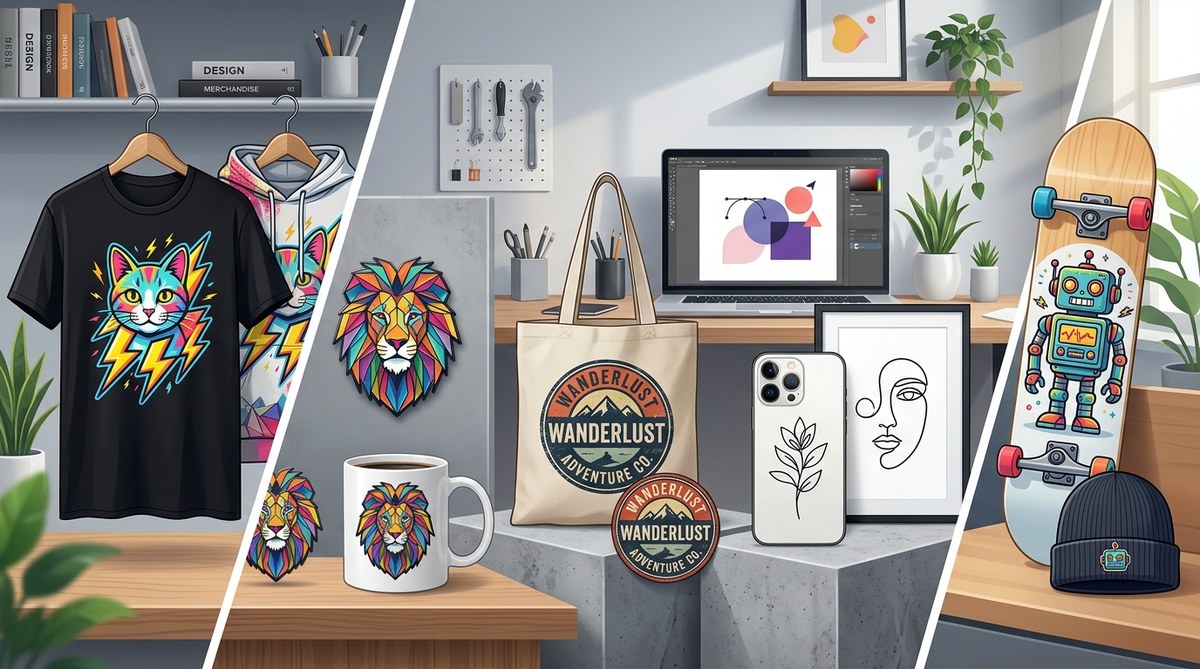
Choosing the right vector art style for your merchandise can feel like picking a favorite song on a great album. Each one hits differently, and the wrong choice might leave your audience hitting skip. In 2026, the merchandise landscape is crowded with t-shirts, posters, hoodies, and stickers all fighting for attention. The difference between a design that sits on a shelf and one that flies off the rack often comes down to style. Vector art, with its clean lines, scalability, and editability, gives you the freedom to experiment without losing quality. But which styles actually move units? Let’s break down five vector art styles that are perfect for merchandise right now, and how you can use them to create work people want to wear and display.
The most successful merchandise designs in 2026 match style to audience. Retro-wave and pop maximalism attract younger buyers on platforms like Redbubble, while clean minimalism and hand-drawn vectors appeal to boutique brands and Etsy customers. Learn the strengths of each style, test on mockups, and always keep production constraints in mind. One style can define your entire merch line.
The Core Styles That Sell in 2026
Every year brings subtle shifts in what resonates with buyers. In 2026, the vector art styles that dominate merchandise design fall into five clear categories. Each has its own visual language, emotional pull, and best-use case. Let’s walk through them one by one.
1. Retro-Wave and Synthwave Revival
This style never truly left, but in 2026 it has matured beyond neon grids and palm trees. Current retro-wave vector art uses bold gradients, chrome-like reflections, and pixel-inspired shapes. It works especially well on apparel because the high contrast reads from a distance. Think sunset palettes, cassette tapes, and grid landscapes with a modern twist.
What makes it great for merchandise: the nostalgia hook is strong, but the style feels fresh when combined with current typography trends. Use it for music festival merch, gaming community tees, or any product aimed at millennials and Gen Z.
2. Flat Minimalism with a Punch
Minimalism has evolved. The old school flat style (simple shapes, no gradients) still has its place, but buyers now expect a bit of personality. In 2026, flat minimalism adds subtle texture overlays, slight depth using offset layers, and unexpected color pops. It remains the safest choice for corporate merch, but when done right it can also sell on lifestyle products.
The secret is negative space and clever composition. A single vector icon can become the entire design if it carries a strong message. This style pairs well with clean serif or sans-serif type. If you want to master the fundamentals, check out this guide on mastering minimalist logo design for modern brands.
3. Hand-Drawn and Sketchy Vectors
People are tired of overly polished, machine-made art. Hand-drawn vector styles bring back human warmth. In 2026, this means using pressure-sensitive brushes inside vector software to create lines that feel organic, not rigid. The effect is rough edges, varying stroke widths, and a loose attitude.
Merchandise with hand-drawn vectors often sells well on platforms like Etsy and independent brand stores. It communicates authenticity. Think about greeting cards, tote bags, and coffee mugs with quirky illustrations. This style also works beautifully for editorial designs on posters. For more on converting raw sketches into vectors, see how to convert hand-drawn art into vector graphics.
4. Bold Line Art and Blackwork
Line art has evolved from simple outlines to intricate, single-weight structures. The vector art styles for merchandise design in this category range from tribal-inspired patterns to detailed botanical drawings. The key is using thick, consistent lines (often 2pt or more) to ensure the design holds up in single-color print runs.
This style is a favorite for screen printers because it reduces setup costs. One color, one screen, massive impact. It also looks incredible on dark garments when printed in white or metallic ink. If you want to build a portfolio around this approach, the article on how to build a vector art portfolio that attracts clients is worth reading.
5. Pop Maximalism
At the opposite end of the spectrum from minimalism, pop maximalism embraces chaos. Overlapping shapes, bright clashing colors, layered textures, and multiple focal points. In vector form, this style demands careful stacking and clipping masks to keep file sizes manageable.
Pop maximalism dominated streetwear and limited drops in 2025 and continues strong into 2026. It appeals to collectors and hype buyers. The designs often tell a story through busy compositions. Think of a t-shirt that has hidden details in every corner. For inspiration on staying ahead of these trends, look at the top trends in vector artwork that every designer should know.
How to Choose the Right Style for Your Merch
You don’t have to pick one and stick with it forever. But for any given product line, a focused style creates brand recognition. Here is a numbered process to help you decide.
- Define your audience. Are they gamers? Outdoor enthusiasts? Office workers? Each group responds to a different visual language.
- Match the style to the printing method. Screen printing loves bold line art and flat minimalism. DTG (direct to garment) can handle gradients and textures from retro-wave or pop maximalism.
- Test mockups. Use a template to see how the design looks on a folded t-shirt or a tote bag. Some styles that look great on screen fall flat in real product photos.
- Consider color count. More colors increase printing cost. If you are starting with a small budget, stick to two or three colors per design.
- Gather feedback. Show your top three mockups to a small group of potential buyers. Let them tell you which style speaks to them.
Common Mistakes When Applying Vector Styles to Merch
Even a beautiful style can tank if you make these errors. Here is a table that maps common mistakes to the style most at risk.
| Mistake | Affected Style | Why It Hurts |
|---|---|---|
| Too much detail at small scale | Pop maximalism | Tiny elements become mud on a 5-inch print area |
| Weak contrast on dark fabric | Flat minimalism | Light colors disappear on black shirts |
| Unclosed paths causing strange fills | Hand-drawn vectors | Gaps in lines look accidental, not intentional |
| Overuse of neon gradients | Retro-wave | Can look dated if not paired with modern composition |
| Single line weight on complex shapes | Bold line art | Loses visual hierarchy; everything blends together |
“The best vector merch designs are the ones that look great as a thumbnail on a phone screen and even better in person. That simplicity is harder to achieve than you think.” – Vector artist Jess K. (from a 2026 panel on print-on-demand design)
Tools and Techniques to Nail Each Style
No matter which style you choose, the right workflow saves hours of frustration. Here are bullet points covering essential approaches.
- For retro-wave: Use the gradient mesh sparingly. Most of the effect comes from dividing the canvas into diagonal swaths of color.
- For flat minimalism: Stick to a three-color palette max. Use geometric shapes and consistent corner radii.
- For hand-drawn vectors: Use a drawing tablet with pressure sensitivity. Then apply the “Simplify” path command to reduce unnecessary anchor points.
- For bold line art: Use the “Offset Path” function to create parallel lines quickly. Group everything before exporting.
- For pop maximalism: Build each layer in a separate clipping mask. Label layers clearly so you can edit later.
Bringing the Styles Together in a Unified Brand
If you run an apparel brand, you do not need to commit to one vector art style for all your products. Many successful brands rotate styles by collection. The trick is keeping a consistent thread: a recurring character, a signature color, or a specific typography choice. That way each drop feels like it belongs to the same family even when the visual approach changes.
For example, a brand might release a retro-wave design for summer and a hand-drawn sketch for fall. As long as the logo and packaging are consistent, customers recognize the brand voice. This strategy works especially well for small shops trying to test different markets without confusing their audience.
Where to Find Inspiration Without Copying
It is tempting to scroll through Dribbble or Behance and replicate what is popular. Instead, look at non-design sources. Vintage album covers, textbook diagrams, street signs, and even food packaging can spark a fresh vector direction. When you combine an unexpected reference with one of the five styles above, you create something original.
For more ideas on refining your vector art skills, read mastering vector art techniques for stunning digital creations. It covers the technical foundations that make any style shine.
Testing Your Designs Before Production
Before you send a design to print, run it through a checklist. First, scale it down to the smallest print size you plan to use. If details disappear, simplify. Second, check the stroke alignment. A stroke that is centered on the path may cause issues with cut vinyl. Convert strokes to outlines for safety. Third, simulate the color on the intended fabric color. What looks great on white might vanish on navy.
A good habit is to order a single sample before bulk production. That sample reveals problems no mockup can show: how the fabric stretches the design, how it feels to the touch, and how it looks under store lighting.
Your Next Move
You now have a solid understanding of the five vector art styles that are driving merchandise design in 2026. The next step is to pick one style and create a small collection around it. Start with three designs. Apply them to two or three product types (t-shirt, poster, sticker). Post the mockups on social media and ask for honest reactions. The feedback will guide your next batch.
If you need a deeper reference on the specific workflow for each style, our pillar guide on 5 vector art styles perfect for merchandise design breaks down software settings, color palettes, and export specs for every approach. Bookmark it and come back as you refine your craft.
Remember, the best vector art for merchandise is the kind that makes someone stop scrolling, smile, and hit “add to cart.” With these styles in your toolkit, you are already ahead of the curve.