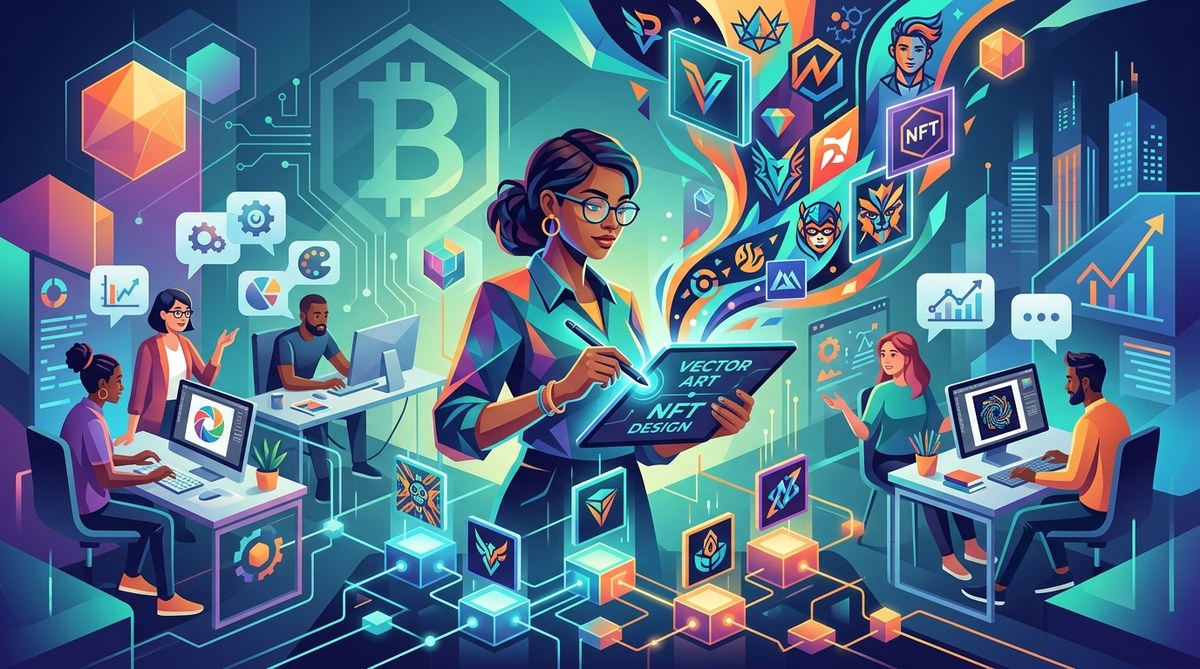
The NFT world moves fast. One month everyone talks about pixel art, the next it’s generative collections. But through all the noise, vector art keeps showing up in high-value drops and community favorites. It’s not a trend. It’s a tool built for the blockchain. Vector files stay small, scale to any size, and look crisp everywhere from a phone screen to a gallery wall. That matters when collectors want art that works across platforms and devices. So is vector art the future of NFT design? We asked working artists and dug into the data. The answer is more layered than a simple yes or no.
Vector art is not just a passing style in the NFT space. Its scalability, low file weight, and crisp output make it ideal for blockchain display and resizing across marketplaces. Artists who master vector workflows gain a technical edge, especially as generative art and layered PFP collections demand clean, editable assets. The future favors creators who combine vector precision with storytelling.
Why Vector Art Fits the NFT Mold
Vector art and NFTs share a fundamental trait: both are built on code. A vector file describes shapes and colors mathematically, just as a smart contract defines ownership on-chain. That symmetry is more than poetic. It matters for collectors and creators.
Here’s why vector art works so well for NFTs:
- Scalability without quality loss. A vector NFT looks sharp at 100 pixels or 10,000. No blurry edges.
- File size stays tiny. Most vector NFTs weigh under 1 MB, meaning lower gas fees for minting and less storage cost for the blockchain.
- Easy layering and animation. You can build a series of traits (eyes, hats, backgrounds) as separate vector layers and combine them programmatically. This is the backbone of many generative PFP projects.
- Clean export to multiple formats. Sell a vector file as SVG, then offer raster PNGs for social avatars. One source, many outputs.
- Vector art reads well on small screens. NFT marketplaces display tiny thumbnails. Vector shapes hold their form; raster details get lost.
“I switched to vector for my NFT series because the collectors wanted to zoom in. With vector, they can see every line without artifacts. That trust is everything in a crowded market.”
– Maya T., digital artist and NFT creator since 2021
That trust comes from reliability. Buyers know the art won’t degrade if they save it or share it. Vector files are essentially future-proof. And in a space where media files sometimes get lost or corrupted, that matters.
What Vector Artists Are Saying About the NFT Shift
We talked to several artists who have been active in the NFT scene since before the 2021 boom. Most agree: vector art’s role is expanding, not fading. The early days favored pixel art and 3D renders, but the market has matured.
One recurring point is that vector art allows for iterative design without starting from scratch. When a collector wants a variation or a derivative, the vector artist can open the .ai or .svg file, tweak colors, and export a new version in minutes. Raster artists often have to repaint entire sections.
Another factor is the rise of on-chain generative art platforms like Art Blocks and fxhash. Many generative scripts output vector shapes using p5.js or SVG. That’s vector at its core. The future of generative NFTs is heavily vector-based.
But vector art also comes with a learning curve. Artists who are used to painting with pixels sometimes struggle with the logical, path-based approach of vector tools. That’s where focused practice comes in. If you want to strengthen your vector fundamentals, check out our guide on mastering vector art techniques to get comfortable with anchor points and curves.
3 Practical Steps to Create Vector Art for NFTs
Each step below assumes you already have a basic vector tool like Adobe Illustrator, Affinity Designer, or Inkscape. The process applies to both single-edition pieces and generative collections.
-
Design with the final platform in mind. Most marketplaces display a square crop, usually 1:1 ratio. Set your artboard to 2400×2400 pixels at 300 DPI. Even though vector resolution isn’t tied to pixels, this gives you a reliable canvas for previews. Keep important elements away from the edges to avoid clipping.
-
Organize your layers for generative minting. If you’re building a PFP collection, name each layer with the trait category (e.g., “Background.red”, “Eyes.blue”). Use a consistent naming convention. Generative tools like HashLips or ChainLink’s VRF read layer names to assemble combinations. Messy layers cause broken outputs.
-
Export in SVG and prepare a fallback. Upload the SVG file to the blockchain if the platform supports it (many do now). Also generate a high-res PNG (at least 4000×4000) for social media and previews. Offer both to collectors. Some marketplaces still don’t render SVG thumbnails correctly, so the PNG acts as a safety net.
For more workflow speed tips, see our article on 5 vector art workflow hacks that can cut your production time in half.
Common Mistakes When Minting Vector NFTs (and How to Avoid Them)
Even experienced vector artists hit snags when moving their work to the blockchain. Here’s a table of frequent pitfalls and straightforward fixes.
| Mistake | Fix |
|---|---|
| Using complex gradients that bloat file size | Simplify gradients to two or three stops. Use solid shapes where possible. |
| Embedding fonts in the SVG | Convert all text to paths (outlines) before exporting. Font licenses often don’t cover NFT distribution. |
| Forgetting to set a transparent background | Always check the artboard background. A white box behind your art can ruin the collector’s ability to use the asset. |
| Overlapping paths that cause rendering glitches | Use boolean operations (Unite, Minus Front) to merge shapes. Clean up stray anchor points before export. |
| Ignoring metadata requirements | Most marketplaces let you attach attributes (trait names, rarity). Fill these in during minting. Missing metadata hurts discoverability. |
Avoiding these mistakes is part of building a professional reputation. If you’re still struggling with path cleanup, read our guide on mastering anchor points for cleaner vector lines.
Tools and Techniques to Master in 2026
The vector NFT landscape in 2026 is more mature than it was two years ago. Several tools have become industry standards for creators who want to mint efficiently.
- Adobe Illustrator remains the most popular for its robust plugin ecosystem and SVG export options. Its “Asset Export” panel lets you batch export layers as individual files.
- Figma is gaining ground for collaborative generative projects. Its component system works well for assembling trait sets.
- Inkscape is free and open-source. It handles SVG natively, making it a great choice for creators on a budget.
- Blender’s Grease Pencil isn’t pure vector, but it blends vector lines with 2D animation. Some artists use it for animated vector NFTs.
For a deeper look at which software to learn, check our list of 10 vector art tools every designer should master by 2026.
Technique-wise, mastering isometric projection can set your vector NFTs apart. Isometric vector art looks 3D without the weight of a full render. Many successful NFT projects use isometric landscapes or architecture. Also learn color theory for limited palettes. Vector art often looks best with 5 or fewer colors per piece. That constraint forces you to be intentional.
The Vector Art NFT Future: Trends Shaping the Next Wave
So where is the vector art NFT future heading in 2026 and beyond? We see three clear directions.
First, generative vector collections will dominate. Because vector files are lightweight and composable, they’re the ideal format for algorithmically generated series. Expect more projects to release their entire collection as SVGs, with owners able to download and remix their specific piece.
Second, motion and interactivity are blending with vector design. SVG supports animation via CSS and JavaScript. Some artists are embedding hover effects or simple loops into their NFT files. That adds value without increasing file size much. Platforms like OpenSea and Rarible now support animated SVGs natively.
Third, vector art is becoming a gateway for traditional illustrators. Many illustrators who work with pen and ink are scanning their drawings and converting them to vector. That bridge between analog and digital is strong. If you’re looking to do that, see our tutorial on converting hand-drawn art into vector graphics.
Vector art won’t replace painting or 3D in the NFT space. It doesn’t have to. Its role is specific: clean, scalable, editable assets that run on the same logic as the blockchain itself. For artists willing to learn the vector mindset, the opportunity is wide open.
Vector Art in the NFT Market: Your Next Step
You don’t need to be a master of curves to start. Pick one small project. Design a single vector NFT that means something to you. Mint it on a low-fee chain like Polygon or Solana. See how it feels. Then build from there.
The artists who will lead the vector NFT future are not the ones with the most followers. They’re the ones who show up consistently, refine their craft, and share their process. Vector art rewards patience. Every anchor point you place is a decision. Every curve you shape adds to your visual voice.
If you want to stay ahead of trends, bookmark our top trends in vector artwork page. And if you’re ready to build a portfolio that attracts collectors, read our advice on building a vector art portfolio. The tools are ready. The market is waiting. Your vector style is the only thing left to create.