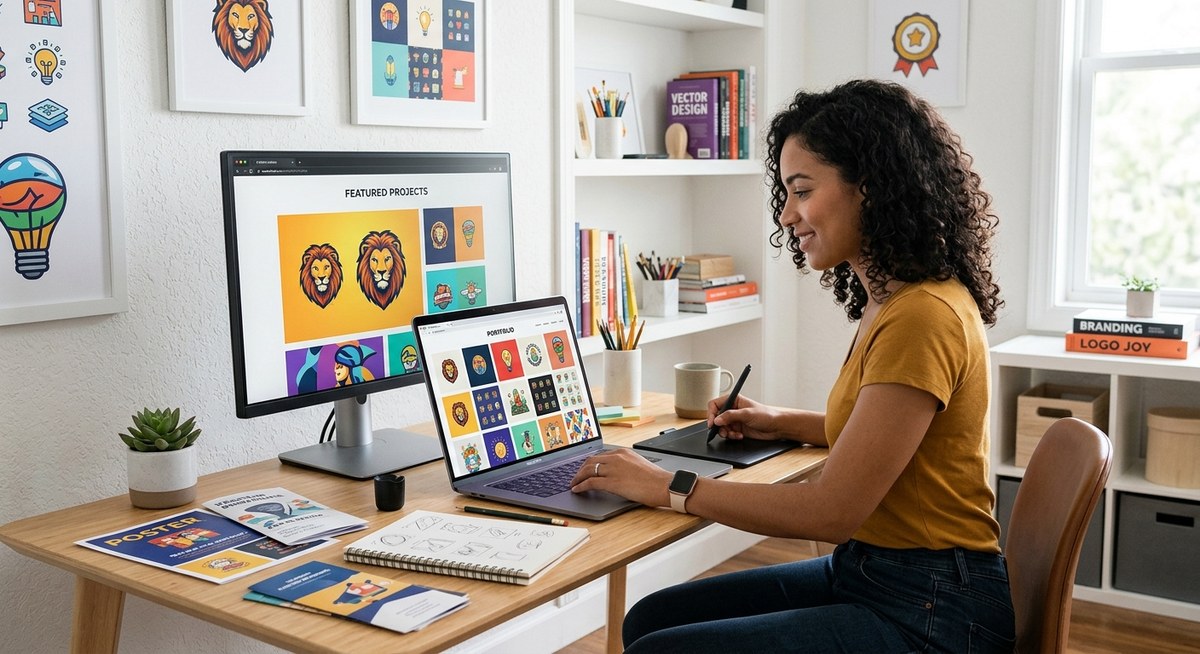
Your vector art portfolio is the gateway to your next client. It tells a story about your style, your skills, and your reliability. A strong portfolio does more than show pretty images. It builds trust and makes it easy for a brand, agency, or art director to say yes. Whether you are just starting out or you have been freelancing for years, your vector art portfolio needs to work as hard as you do. Let us walk through exactly how to build one that brings in the right projects.
Your vector art portfolio must be curated with intention. Only include work you want to be hired for, keep it under 15 pieces, and write clear project stories. Choose a platform that loads fast and looks clean. Update your portfolio every season. Avoid clutter, bad navigation, and outdated styles. When your portfolio feels focused and professional, clients will trust you with their next project.
Why Your Portfolio Matters More Than Your Skill
Clients cannot see your full process or your years of practice. They see your website. Your vector art portfolio is the only proof they need. If your site is messy or confusing, they will assume your files are messy too. If your work samples are all over the place, they will think you do not have a clear style. That is a hard pass for most creative directors.
In 2026, the freelance market is more crowded than ever. But the artists who get steady work are not always the most talented. They are the ones who present their work with clarity and confidence. Your vector art portfolio is your silent salesperson. Make it speak clearly.
The Core Rule: Show Only What You Want to Be Hired For
This is the single most important rule for building a vector art portfolio. Do not include everything you have ever made. Only show pieces that represent the type of work you want to do next.
- If you want more editorial illustration gigs, include editorial work.
- If you want logo projects, show your logo case studies.
- If you want character design contracts, focus on characters.
- If you are still building samples, create spec work that matches your dream client.
Leave out the old experiments, the unfinished sketches, and the projects that do not reflect your current skill level. Every image in your vector art portfolio should make a client think, "I want that for my brand."
How to Build Your Vector Art Portfolio Step by Step
Follow this simple process to create a portfolio that actually gets you hired.
-
Define your niche. What kind of vector art do you love making? Is it flat illustration, isometric icons, branded mascots, or something else? Pick one or two specialties and build your portfolio around them. A focused portfolio wins over a scattered one every time.
-
Curate 10 to 15 of your strongest pieces. Resist the urge to add more. Clients have short attention spans. Use your best work first. Arrange the pieces so the strongest image sits at the top.
-
Write a short project story for each piece. Do not just label a file "portfolio image 4." Instead, write one or two sentences that describe the project. Explain your role, the goal, and the outcome. For example: "Created a series of vector icons for a health app. The client needed scalable graphics that worked on mobile and web. The project reduced load time by 30 percent." This shows you understand business goals, not just aesthetics.
-
Choose the right platform. Your vector art portfolio needs to load fast and look good on every device. Options like Adobe Portfolio, Squarespace, or a custom site built with Webflow or WordPress work well. Avoid clunky PDFs or social media feeds as your main portfolio. A professional website signals that you are serious.
-
Make your contact info impossible to miss. Include a dedicated "Contact" page or button. Add your email, a contact form, and links to your professional social accounts (Dribbble, Instagram, LinkedIn). Make it easy for someone to hire you.
-
Update your vector art portfolio every three months. Remove older pieces that no longer represent your best work. Add new projects as you complete them. A stale portfolio makes clients wonder if you are still active.
Common Mistakes That Push Clients Away
Even talented artists lose opportunities because of small portfolio mistakes. Here is a table of the most common errors and how to fix them.
| Mistake | How to Fix It |
|---|---|
| Too many pieces (20+) | Cut down to 10 to 15. Quality over quantity. |
| No project descriptions | Add a short story for each image. Explain context. |
| Slow loading images | Compress your files. Use WebP or optimized JPEGs. |
| Missing contact info | Place a visible "Contact" button in the header. |
| Outdated style | Swap old work for fresh pieces every season. |
| No clear niche | Pick one or two specialties and stick with them. |
Avoid the temptation to fill your vector art portfolio with everything you can do. Clients do not hire generalists for big projects. They hire specialists who clearly own a style.
Expert Advice From a Working Freelancer
"I rebuilt my vector art portfolio three times before I started getting consistent client inquiries. The turning point was when I removed half of my older illustrations and wrote real project stories. Suddenly, brands could see my thinking, not just my colors. If your portfolio feels like a collection of random art, clients will treat you like a hobbyist. If it feels like a service, they treat you like a professional." — Maria K., freelance vector illustrator with 8+ years of experience
That shift from "look at my art" to "here is how I solve your problem" is everything. Clients want to hire someone who understands deadlines, feedback, and deliverables. Your vector art portfolio should prove that.
Making Your Portfolio Stand Out in 2026
Trends change, but good portfolio strategy stays the same. Here are a few extra tips to give your vector art portfolio an edge this year.
- Include a case study format. Instead of a flat gallery, try a case study layout. Show the problem, your process sketches, the final vector art, and the result. This shows your problem solving skills.
- Add a short intro video. A 30 second video of you talking about your favorite project builds a personal connection. Keep it natural and unscripted.
- Link to your related skills. If you also do hand drawn art that you later vectorize, learn how to convert hand drawn art into vector graphics. That technical skill is a big selling point for many clients.
- Show your versatility within your niche. For example, if you specialize in flat illustration, show different subjects: people, animals, objects, scenes. This proves you can handle variety while staying on brand.
- Ask for feedback. Before you launch your vector art portfolio, ask two or three fellow designers to review it. They will catch issues you missed.
If you want to sharpen your technical skills further, check out our guide on mastering vector art techniques for stunning digital creations. Strong technique makes portfolio pieces pop.
The Role of Presentation and Branding
Your vector art portfolio website is also a branding tool. Use consistent colors, fonts, and spacing that match your artistic style. If your art is playful and colorful, your website should feel playful and colorful too. If your work is minimal and clean, keep the site minimal.
Do not let the design of the website overpower your art. The art should be the star. Use plenty of white space, large images, and minimal text. Let your vector art breathe.
Also consider adding a short "About" page. Tell visitors who you are, what you love to draw, and that you are available for freelance projects. Keep it friendly and professional.
Ready to Attract Your Ideal Clients
Your vector art portfolio is one of the most powerful tools in your freelance career. Spend the time to make it focused, clean, and client friendly. Remove the fluff. Write real project stories. Update it regularly. When your vector art portfolio reflects your best work and your clearest thinking, the right clients will find you.
Start today. Pick five pieces from your current collection and ask yourself: "Would I hire myself for this?" If the answer is no, swap them out. Then add a project story for each remaining piece. That small step will already put you ahead of most artists.
Remember, every major freelance opportunity starts with someone seeing your vector art portfolio. Make sure that first impression is unforgettable.